

Growing on TikTok, or “breaking through,” has no single definition, but in practice it’s the moment one or more videos clearly beat an account’s usual reach and bring it a lasting audience and steady follower growth. TikTok documents no formula that guarantees it, but a method consistent with what the platform explains about how it works improves your odds.
Why there’s no guaranteed recipe
TikTok explains how its recommendations work in its Newsroom: the For You feed relies on viewer interactions (videos liked, shared, commented on or watched to the end), on video information (captions, sounds, hashtags) and, with less weight, on device and account settings. Neither follower count nor an account’s past successes are direct factors, and the platform publishes no view threshold or ideal posting time. Our guide to the TikTok algorithm in 2026 covers this mechanism in depth.
The lack of a guaranteed recipe isn’t bad news: it means breaking through depends on factors you can actually work on (the hook, the format, consistency) rather than on a magic posting time or a stroke of luck.
How long does it take to grow on TikTok?
There’s no standard timeline, and TikTok publishes no average. Based on creators’ observations, three scenarios often come up:
- Under two months, when the creator has already found a format and a niche that work, often because they studied what works for comparable accounts before starting.
- Two to six months, the time it takes to test several formats, hooks and topics, and see what really stands out from the account’s baseline.
- More than six months, when the niche or format chosen at the start doesn’t match what the target audience is looking for, which forces a change of strategy along the way.
The number of well-made attempts matters more than the time spent: an account that posts one video a week has fewer chances to take off than one that posts 4 or 5 of comparable quality, simply because every post is a new chance to be recommended.
Step 1: pick a specific niche
An account about “everything I’m into” spreads its audience thin and makes it harder for the algorithm to figure out who to recommend the content to. A specific niche (an angle, an audience, a recurring type of content) makes it clearer who each new video is for, to the algorithm and to viewers alike.
If your target niche is already crowded, you need a more distinctive angle: copying the format of a million-follower account as-is drowns a new voice in a feed viewers already know. A niche that’s still underserved leaves more room for a simple but well-executed format.
Before you start, looking at what already works for comparable accounts in your target niche gives you concrete clues about which formats have a shot at holding that specific audience’s attention. Our guide to social media competitive analysis explains how to do this research methodically.
Step 2: write a hook that holds viewers in the first 3 seconds
TikTok cites watching a video all the way through as a strong indicator of interest. So the first few seconds decide everything: a vague hook or a generic intro loses part of the audience before you’ve had a chance to win them over.
An effective hook usually follows one of these approaches:
- A clear promise: what the viewer will learn or see if they stay.
- Tension or an open question that creates a need for resolution.
- An unexpected visual in the very first frame that stops the scroll.
- A deliberately divisive statement that makes people stay to understand the reasoning.
Step 3: give viewers a reason to comment and share
Beyond watching to the end, sharing and commenting take more effort than a simple like, which makes them clearer signs of interest. An open question at the end of the video, a statement that mildly splits opinion, or content relatable enough to send to a friend all make those actions more likely.
Step 4: post consistently, at a pace you can sustain
Posting frequency helps discovery because it multiplies your chances of being recommended, but volume alone isn’t enough. TikTok also states, on the page cited above, that it doesn’t recommend duplicated content or content considered spam, so reposting the same video to keep up a pace gets you nowhere. A pace of 3 to 5 posts a week that you can keep up for several months is far better than an unsustainable daily pace that collapses after two weeks.
Step 5: judge your performance against your own baseline
The most common mistake when you’re trying to break through is comparing your views to market figures or to established accounts instead of your own history. A video with 15,000 views can be a very positive signal for an account that usually tops out at 2,000 views, and a relative flop for an account that often goes past 100,000.
That’s the principle Creadar applies to the accounts tracked in a watchlist: each creator has their own medians, calculated on their last 20 eligible videos, and a post becomes an “outlier” when its views or engagement reach 3 times the matching median. Applying the same reasoning to your own account, even without a tool, changes how you judge whether a content strategy works: see our guide on how many views it takes to go viral on TikTok to go deeper.
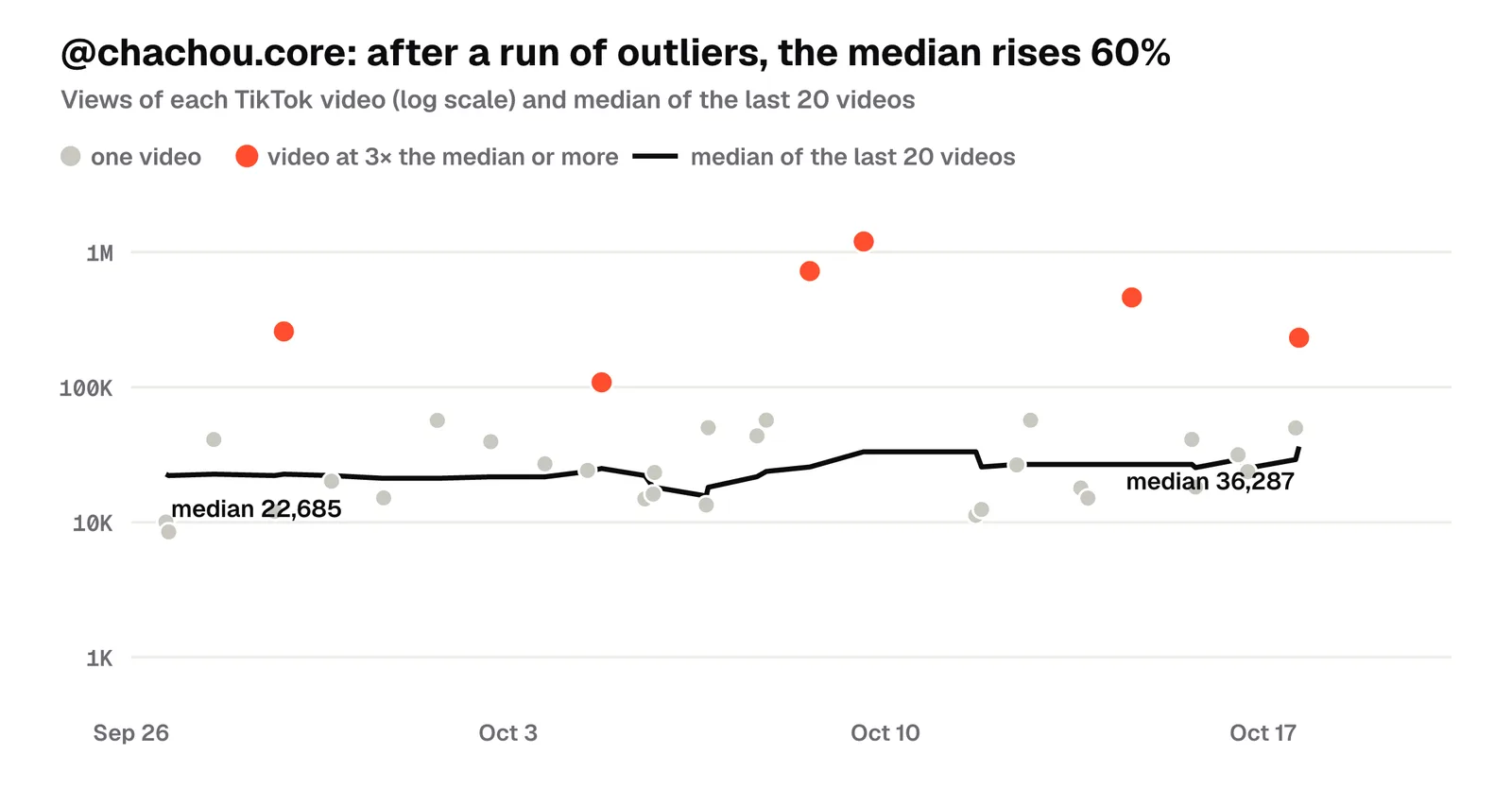
This beauty account posts almost every day. Several of its videos go past 3 times its median, including two at 723,932 and 1,198,158 views on October 8 and 9, more than thirty times the late-September median (22,700 views). In the days that follow, the median of the last 20 videos climbs to 36,287 views: “normal” videos now do better than before. That’s what breaking through looks like in the data: a baseline that shifts upward after a run of outliers, rather than one isolated hit.
Step 6: watch your niche to speed up testing
Noticing a format that keeps coming back across several comparable accounts, all outperforming at the same time, is a more actionable signal than testing at random. A small watchlist of 10 to 20 accounts in your niche is enough to spot these patterns before adapting them to your own content; tracked by hand, it stays manageable up to about 10 to 15 accounts. Our complete guide to social media competitive analysis walks through this method step by step, from the free version to dedicated tools.
The most common mistakes that slow down your growth
Comparing your views to a big account’s instead of your own median. Setting a goal like “hit 100,000 views” without accounting for your starting scale pushes you to drop a format that actually works, just because it doesn’t reach a number disconnected from your account’s reality.
Switching niches too fast. Testing an angle for only three or four videos doesn’t give you enough data points to judge whether the format works: results vary a lot from one video to the next, even between two similar posts.
Copying a format without understanding how it works. Reusing a hook or an edit that worked elsewhere without understanding why it holds attention (pacing, tension, promise) often falls flat, because a literal copy loses the element that made the original work.
Ignoring engagement and looking only at views. A video with lots of views but few comments or shares points to passive interest more than to the momentum that makes an account break through for good.
Growing on several platforms at once: a good idea?
Many creators post the same short-form content on TikTok, Reels and YouTube Shorts at the same time, hoping to multiply their chances of breaking through. The idea holds up, as long as you don’t judge all three platforms by the same yardstick: their recommendation systems differ (see our guide to the Instagram algorithm in 2026 for the comparison), and an audience can react differently to the same format depending on the platform. An account that breaks through on TikTok first won’t automatically break through on Instagram with the same content: you usually need to adjust the edit, the pacing and sometimes the hook slightly for each platform, even when you start from the same video idea.
What if months go by without any signal?
A long stretch without a positive signal doesn’t necessarily mean an algorithm problem: start by checking three concrete things. Does your format really match what your niche’s audience watches to the end, or does it reproduce a structure that worked elsewhere without adapting it? Have you made enough attempts to judge, or has the account simply posted too few videos for the natural variation from one video to the next to play out? Finally, is the technical quality (clear audio, stable framing, an edit that doesn’t drag) on par with what’s already circulating in your niche? Going back over these three points before overhauling your strategy keeps you from dropping a direction that just needed more repetitions.
The bottom line
Breaking through on TikTok in 2026 doesn’t depend on a magic posting time, on your starting follower count or on extreme posting volume. It depends on a well-defined niche, a hook that grabs attention in the first seconds, a sustainable posting rhythm, and a clear-eyed read of your progress against your own baseline instead of market figures. Watching what works for comparable accounts speeds up this testing phase, without ever replacing it.
To go further, read our guide to the TikTok algorithm in 2026 to understand the exact signals the platform documents, and our social media competitive analysis method to build your own niche monitoring.