

Instagram has been saying it in its own official posts since 2021: there isn’t a single algorithm, but several separate systems, one for each part of the app. Here is how those systems work, based on what Instagram and Adam Mosseri have published themselves.
What Instagram has officially published
Four official Instagram/Meta sources describe how ranking works:
- “Shedding More Light on How Instagram Works”, published by Adam Mosseri in June 2021.
- “Instagram Ranking Explained”, Adam Mosseri’s May 2023 update of the same post, which remains the most detailed reference Instagram has published on how Feed, Stories, Explore and Reels are ranked.
- The help page “Recommendations on Instagram”, which details the criteria for being eligible for recommendations.
- The announcement of the “Your Algorithm” feature in December 2025, on about.instagram.com.
There isn’t “one” Instagram algorithm
This is the point most often overlooked when people talk about the topic. Instagram spells it out: “Instagram doesn’t have a singular algorithm that oversees what people do and don’t see on the app. We use a variety of algorithms, classifiers, and processes, each with its own purpose.” Feed, Stories, Explore and Reels each have their own ranking logic, tailored to how people use them: keeping up with friends in Stories, discovering new content in Explore, being entertained in Reels.
One direct consequence: a trick that gets you better distribution in Explore won’t necessarily work for Reels, because they are two different ranking systems, each with its own signals and weights.
How Instagram ranks Reels
For Reels, Instagram says it works in two steps: first it gathers a set of reels you’re likely to enjoy, then it orders them by estimated interest. Most of what people see in the Reels tab comes from accounts they don’t follow, as in Explore.
Instagram says it primarily predicts how likely you are to reshare a reel, watch it all the way through, like it, or go to the audio page (an indirect sign that you might want to create your own content with that audio). The most important signals, in the order Instagram gives, are:
- Your activity. The reels you’ve recently liked, saved, reshared and commented on.
- Your history of interacting with the account that posted. Even though most of the reels people see come from accounts they’ve never come across, a past interaction makes interest more likely.
- Information about the reel itself. The audio track, the visual content analyzed pixel by pixel, and its overall popularity.
- Information about the account that posted. Popularity signals such as follower count or engagement level, so that a wide range of creators can find their audience.
What makes a reel ineligible, before performance even comes into it
Before looking at why a video performs or doesn’t, Instagram applies the eligibility criteria described in its help page “Recommendations on Instagram”. Content can stay visible to your followers yet never be recommended to people who don’t follow you if it breaks the recommendation guidelines.
In its official publications, Instagram explicitly lists these factors as reducing visibility in recommendations:
- a visible watermark (for example, one left by another app);
- low resolution or a blurry video;
- a reel with no audio;
- borders around the video;
- content that is mostly text rather than video;
- content already posted elsewhere on Instagram.
If an account repeatedly breaks the recommendation guidelines, none of its content is eligible for recommendations for a period of time, which is different from having content removed.
“Shadowbanning”: Instagram’s official answer
Instagram devotes a whole section of its 2023 post to “shadowbanning”, a term the platform acknowledges creators use in very different ways. Its official position is that limiting or hiding an account without explanation is “not our intention”, and that artificially holding back a creator’s reach goes against Instagram’s business interests, since creators’ growth benefits overall use of the platform. Instagram also states explicitly that it doesn’t suppress content to encourage people to buy ads.
What the platform does acknowledge is a historical lack of transparency about why visibility gets reduced, which is why it built Account Status, a feature that lets you check whether your account is eligible for recommendations and appeal the decision.
“Your Algorithm”: the late-2025 addition
In December 2025, Instagram launched “Your Algorithm”, a feature that shows the topics Instagram associates with your account to shape your Reels recommendations, and lets you choose which topics you want to see more or less of. Launched on Reels, it is set to expand to Explore, according to the announcement as reported by TechCrunch. It’s a transparency step on the viewer side rather than a change to the ranking mechanism described above for creators.
How Instagram ranks Feed and Explore, beyond Reels
Feed follows a logic close to that of Reels, with a different order of priority: Instagram ranks first by your activity (posts you’ve liked, saved, shared or commented on), then by information about the post (popularity, how quickly it gets engagement, date, location), then by information about the person who posted, and finally by your history of interacting with that person. In Explore, the order changes again: the post’s popularity comes first, followed by your past activity in Explore, your history with the author, then information about the author. This difference in order, which Instagram documents explicitly, explains why a format that takes off in Explore guarantees nothing in Feed, and vice versa: these are two sets of signals weighted differently.
Instagram also says that Feed predictions cover about a dozen possible actions, and the five it watches most closely are spending a few seconds on a post, commenting on it, liking it, sharing it, and tapping the author’s profile photo. The more likely an action is judged to be, and the more heavily the system weights it, the higher the post ranks.
What these signals mean in practice if you post Reels
Cross-referencing Instagram’s official posts, three priorities stand out for an account that wants to be recommended more:
- Hold attention to the very end, since watching all the way through is one of the actions the Reels ranking system predicts most directly.
- Give people a reason to share or to visit the audio page, two signals Instagram explicitly cites as priority predictions, and more meaningful than a simple like.
- Meet the eligibility criteria before you even think about optimization: a visible watermark or a video reposted without changes is enough to sharply limit recommendations, however good the content is.
These principles largely overlap with the ones TikTok describes for its own recommendation system, covered in our guide to the TikTok algorithm in 2026.
How to check what actually works in your niche
The official documentation explains the general mechanism, but it never says which specific topic or format works for your particular audience. That’s where watching accounts comparable to yours on Instagram gives you a concrete signal: noticing that a video from a similar account clearly beats its usual performance is more actionable than theory alone.
That’s the approach Creadar takes: each creator tracked in an Instagram, TikTok or YouTube Shorts watchlist has their own median views and engagement, calculated over their last 20 eligible videos, and a post becomes an “outlier” when its views or its engagement reach 3 times the corresponding median. The threshold is specific to each account.
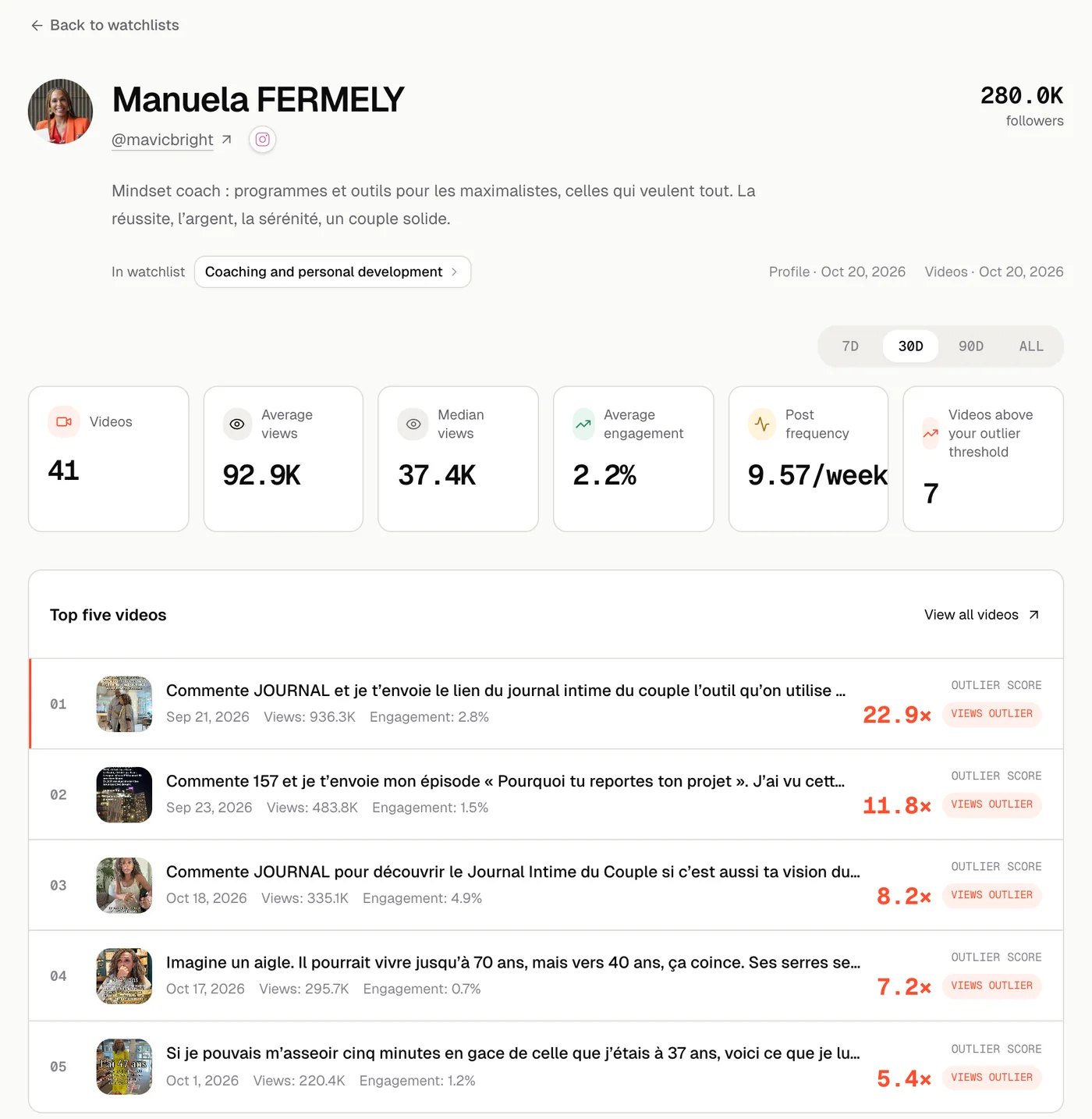
Of this coaching account’s top five videos, three open with the same mechanic: “Commente” (French for “comment”) followed by a keyword (“JOURNAL”, “157”) to receive something by direct message. The best one reaches 936.3K views, 22.9 times the median of the account’s last 20 videos. This format explicitly asks for a comment, and therefore an interaction, and it keeps coming back in the videos that stand out: exactly the kind of pattern a creator page makes visible in seconds.
Creadar only analyzes the accounts you add to a watchlist and doesn’t generate content. Plans range from €18/month (10 tracked creators) to €95/month (100 creators), with a free preview: a one-time analysis of 3 accounts, no credit card required. For a complete method to keep an eye on several accounts in your niche, see our guide to social media competitive analysis.
Reels vs. Feed vs. Explore: what stays the same across sections
Despite different weightings, three mechanisms show up in every section Instagram describes. First, the system always starts by defining a set of candidate content before ranking it, based on what you follow or on what Instagram thinks is relevant to you. Next, it predicts a series of likely actions (staying a few seconds, liking, sharing, commenting) instead of measuring raw popularity. Finally, it applies the same safety and recommendation rules everywhere: content that breaks the Community Guidelines is removed from the whole app, while content that only breaks the recommendation guidelines stays visible to existing followers but loses its chance to be shown to new accounts.
These shared mechanisms give you reference points across the whole app, but you still have to think section by section: understanding Reels helps you read Feed or Explore, yet a Reels strategy won’t carry over as is.
The bottom line
The Instagram algorithm in 2026 stays true to what the platform has been explaining since 2021: several separate ranking systems, one per section of the app, based on your activity, your history with an account, the content’s characteristics and, last of all, the posting account’s popularity. Follower count isn’t the dominant factor, and a reel that meets one of the non-recommendation criteria (watermark, repost, low resolution) has little chance of being recommended, however good it is otherwise. The “Your Algorithm” feature from late 2025 adds transparency on the viewer side without changing these fundamentals.
To go further, read our guide to the TikTok algorithm in 2026, which covers the signals TikTok officially describes, and our social media competitive analysis method to see concretely what works in your niche on Instagram.