

The TikTok algorithm doesn’t “favor” a type of account or a magic posting time. TikTok says that neither follower count nor an account’s past hits are direct recommendation factors: what counts is how viewers react to each video. According to many creators’ observations, a video is first shown to a small audience, then distributed more widely if that first audience watches it to the end, shares it or comments on it. Understanding these mechanics lets you stop guessing and start reading your own data.
How the TikTok algorithm works, according to TikTok
TikTok published its own explanation of the For You feed recommendation system in a Newsroom article, “How TikTok recommends videos #ForYou”. It names three groups of signals:
- User interactions: videos you like or share, accounts you follow, comments you post, content you create.
- Video information: captions, sounds, hashtags.
- Device and account settings: language, country, device type. These signals carry less weight than the first two, because users don’t actively express them as preferences.
The article is explicit on a point that’s often misunderstood: “neither follower count nor whether the account has had previous high-performing videos are direct factors in the recommendation system.” An account with more followers gets more views at the start because it has already built an audience; after that, each video is judged on its own results.
The ranking signals that really count
Not all interactions carry the same weight. TikTok explains that “a strong indicator of interest, such as whether a user finishes watching a longer video from beginning to end, would receive greater weight than a weak indicator, such as whether the video’s viewer and creator are both in the same country.” TikTok doesn’t publish the weight of each signal: the table below is an estimate that combines its explanations with common creator observations.
| Signal | Estimated strength | Why |
|---|---|---|
| Full watch / replay | Strong | Direct proof of sustained interest |
| Share, comment | Strong | Deliberate action that takes effort from the user |
| Like | Medium | Quick, low-effort action |
| Follow after the video | Strong | Intent to see more from this creator |
| Hashtags, caption, sound | Secondary | Helps the system figure out what the video is about |
| Country, language, device type | Weak | Technical settings the user doesn’t express as a preference |
| Account followers | No direct effect | Ruled out by TikTok as a direct factor |
What shapes your feed isn’t what distributes your videos
A common mix-up blends two separate mechanisms. On one side, your interactions (likes, accounts you follow, comments you post) shape your For You feed as a viewer. On the other, the reach of a video you post depends on how the viewers who receive it react; your own activity as a viewer plays no part in it. Liking lots of videos in your niche makes your own feed more relevant, but has no documented effect on the reach of your posts.
This distinction matters because it explains why a creator who comments a lot on TikTok doesn’t necessarily see their own videos get better distribution: these are two separate feedback loops.
TikTok algorithm myths that won’t die
These beliefs keep coming up among creators, with no support in anything TikTok has published:
- “The more I post, the more the algorithm pushes me.” Posting often gives you more chances to be seen, but TikTok never lists frequency as a recommendation factor. A rushed video that nobody watches to the end adds nothing.
- “There’s one magic posting time for everyone.” The right time depends on when your own audience is online. Our guide to the best time to post on TikTok lays out a method based on your own data.
- “Having lots of followers protects my future videos.” TikTok says the opposite: a video doesn’t directly benefit from the success of the ones that came before it.
- “Deleting and reposting a video gives it a second chance.” Nothing in the official documentation backs this up, and TikTok says it doesn’t recommend duplicated content.
- “The algorithm punishes a whole account because of one video.” TikTok’s eligibility standards apply video by video. For what can affect an entire account, see our guide to the TikTok shadowban.
- “You need to target an international audience to break through.” Country and language are among the weak signals; content and retention matter far more.
- “Trending hashtags are enough to get recommended.” They help the system figure out what a video is about, but no hashtag will make anyone watch a video to the end.
How TikTok avoids the filter bubble
The system deliberately breaks up repetitive patterns: the For You feed “generally won’t show two videos in a row made with the same sound or by the same creator,” and it doesn’t recommend content you’ve already seen. TikTok also adds variety on purpose: videos outside your usual interests show up to keep you from getting boxed in and to help the system learn what appeals to a wider audience.
Eligibility: when a video has no chance of being recommended
Before performance even comes into play, a video can be completely shut out of the For You feed. TikTok applies For You feed eligibility standards: it avoids repeatedly recommending some topics (extreme fitness or dieting, sexual suggestiveness, sadness, overgeneralized mental health advice) and makes other content ineligible for the For You feed altogether, as listed in the “FYF Ineligible” sections of its Community Guidelines. The Newsroom article also confirms that “videos that have just been uploaded or are under review, and spam content such as videos seeking to artificially increase traffic, also may be ineligible for recommendation into anyone’s For You feed.”
In other words, before you optimize your hook or your posting time, make sure the video doesn’t break these rules, even unintentionally.
What the data shows: the method to apply to your own watchlist
The official explanation describes the mechanism, but it doesn’t tell you which format works in your specific niche. That’s where watching comparable accounts pays off. In Creadar, each video tracked in a watchlist is compared with the same creator’s last 20 eligible videos: a video becomes an “outlier” when its views or engagement reach 3 times the median of those 20 videos. The threshold is therefore specific to each account.
This relative approach is more reliable than a single global number, because a creator with 5,000 followers and one with 2 million don’t have the same baseline for normal views, yet both can post a video that clearly breaks from their own norm.
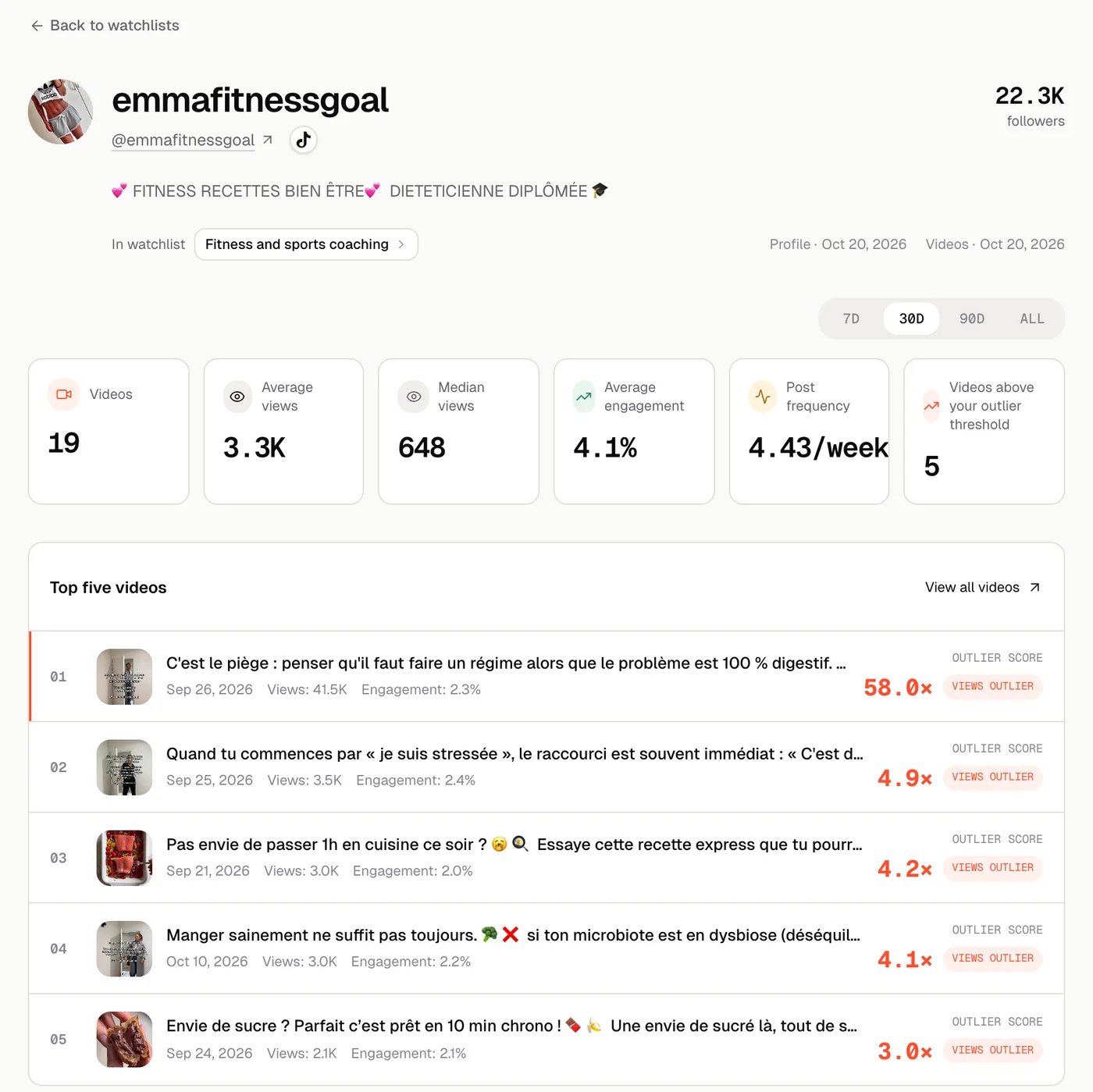
This dietitian posted a video on September 26 that reached 41.5K views, 58 times the median of her last 20 videos, while the next four in her ranking top out between 2.1K and 3.5K. Its engagement (2.3%) is actually lower than the account’s 30-day average (4.1%): viewers didn’t react more than usual; the video was simply shown to far more people. Views far above the norm with lower-than-usual engagement is the profile of a video distributed well beyond the account’s regular audience.
When you watch several accounts in the same niche for a few weeks, you see patterns repeat: the outlier videos in a watchlist often share a hook format, a length or an editing pace. That’s a far more actionable signal than generic advice like “post between 6 and 9 p.m.”
Engagement: a signal you can see without access to TikTok’s internal data
Engagement rate, calculated as (likes + comments) ÷ views × 100, isn’t on TikTok’s list of signals as such, but it partly reflects the interactions that count: a video that sparks comments often keeps viewers watching longer too. The 2026 benchmarks from Socialinsider put TikTok’s average engagement rate by views at 3.85% in 2024 and 4.20% in 2025, a 9% increase in one year, with accounts of 1,000 to 5,000 followers growing the most (from 4.20% to 4.40%). Keep in mind that their formula also counts shares and saves, so these rates can’t be compared directly with a (likes + comments) ÷ views × 100 calculation. They give you a market ballpark; our guide to the average engagement rate on TikTok and Instagram explains how to set your own benchmarks.
How long before you know if a video is taking off
TikTok doesn’t publish any timeframe. Creators commonly observe distribution that starts small, then widens in stages if retention and engagement hold up. According to the same observations, a video that doesn’t take off in its first few hours rarely picks up again days later, unless something outside the video happens (another creator picks it up, it ties into the news, its sound starts trending again). So it’s reasonable to judge a video on its first 24 to 48 hours before moving on to the next one.
How to use these mechanics to your advantage
- Nail the first 3 seconds. That’s when viewers decide whether to stay, and TikTok names watching a video to the end as a strong indicator. A vague hook or a generic intro loses some viewers before the video has a chance to win them over.
- Aim for completion over length. Since a full watch counts as a strong indicator, a short video watched all the way through is worth more than a long one abandoned halfway.
- Give people a reason to comment as well as like. An open question, a statement that gets a reaction or the start of a debate takes more effort from viewers than a like does: it’s a clearer sign of interest.
- Check eligibility before you post. A video that’s ineligible for the For You feed has no chance, however good the editing or the hook. Reread the eligibility standards if your content touches on health, the body or sensitive subjects.
- Compare your videos with your own history rather than with market averages that have nothing to do with your niche. A 10,000-view video can be a flop or a hit depending on your personal median.
- Give it time before drawing conclusions. One weak video means nothing; the trend across several posts is what you can actually interpret.
What if my views drop sharply despite all this?
A one-off dip in views is nothing unusual: it’s the natural variance of a system that evaluates each video separately. A lasting drop across several consecutive posts is a different signal, and you need to tell it apart from an ordinary slump. Our TikTok shadowban guide explains how.
The bottom line
Based on what TikTok has published, the logic is simple: each video is judged on how viewers watch it and react to it, and follower count protects nothing. Rather than hunting for a universal formula, track your results over time and compare them with your own norm, whatever the size of the accounts around you. If you also follow comparable accounts in your niche, spotting their videos that clearly break from their usual median gives you concrete clues about what’s working right now.
To go further on spotting what works in your niche, see our comparisons of the best TikTok trend tools and the best tools for finding video ideas that take off.