

TikTok never confirms a “shadowban” in the sense creators mean it: no official feature by that name exists in its documentation. What is real, documented and verifiable is that a video can become ineligible for recommendation in the For You feed if it breaks certain rules. So the right question to ask is less “am I shadowbanned?” and more “are my recent views consistently below my own norm, or is this normal variance?”
What TikTok officially says (and doesn’t say)
TikTok has never used the term “shadowban” in its documentation. A spokesperson told Fox News Digital in July 2023 that the platform doesn’t “shadow ban” creators, and that it only takes action against an account after repeated violations of its community guidelines. What TikTok does document are very real, named mechanisms:
- Content removal: videos that break the rules are taken down, whether they’re public or private.
- Content restriction: some content is limited to adult audiences.
- For You feed ineligibility: content that doesn’t meet the standards can still be found through search or on the creator’s profile, but is no longer recommended to new audiences.
These rules are set out in TikTok’s For You feed eligibility standards, updated in September 2026. TikTok avoids recommending some topics over and over (extreme fitness or dieting, sexual suggestiveness, sadness, overgeneralized mental health advice), and the “FYF Ineligible” sections of its Community Guidelines list content that is never recommended, such as misinformation that may cause moderate harm, significant adult body exposure, or activities that may lead to moderate physical harm.
How to know if you’re shadowbanned: signs of a real restriction
With no officially named mechanism, the signs creators report are still the most concrete things to watch for:
- Your views plunge across several videos in a row.
- The share of views coming from the For You feed drops sharply in your TikTok analytics (visible in each video’s traffic sources).
- Your videos stop showing up under relevant hashtags, even shortly after posting.
- Your account status flags a violation in TikTok Studio.
None of these signs on its own is definitive proof. It’s their combination, across several consecutive videos, that points to a real problem rather than a normal slump.
A normal drop vs. a real warning sign
This is the point people misread most often. On TikTok, each video is evaluated separately: it’s normal for some to clearly underperform compared with others, for no identifiable reason. A real visibility problem shows in how long it lasts and how widespread it is.
| Situation | Normal | Sign to watch |
|---|---|---|
| A single video below average | Yes, common | No |
| Several consecutive videos well below your personal median | No | Yes |
| No outlier for a few weeks | Yes, outliers are rare by nature | No |
| Share of For You traffic collapsing for a sustained period | No | Yes |
| Account status flagging a violation | No | Yes, cause identified |
The method: compare your recent views with your own median
The most reliable way to judge a drop in performance is to compare it with your own history rather than with an absolute number. That’s the principle Creadar applies: each creator tracked in a watchlist has a median for views and a median for engagement, calculated on their last 20 eligible videos, and a video is flagged as an outlier when its views or engagement reach 3 times the matching median. The reverse also works as a diagnostic: if several recent videos fall well below that personal median and stay there, with none coming close to it, that’s a far more reliable signal than a feeling that “it’s just not working anymore.”
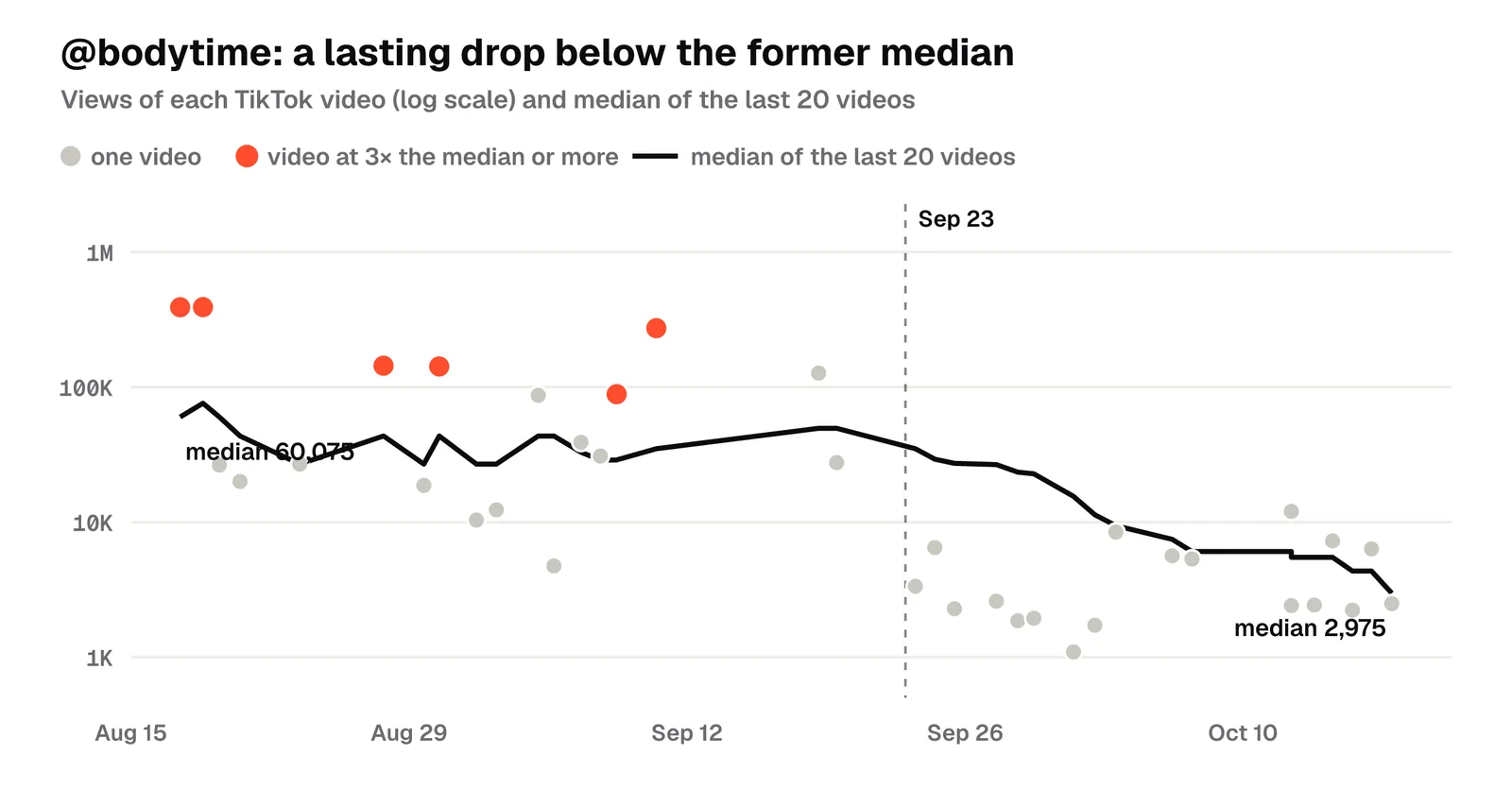
This fitness coaching account offers a real example. Between mid-August and September 22, 15 of its 18 videos topped 15,000 views and 6 got more than three times its median. From September 23 on, none of the next 18 videos went above 12,015 views, and the median of the last 20 videos fell from about 49,500 views on September 22 to under 3,000 on October 17. It’s this pattern, a lasting drop below the old norm, and not just a lack of outliers, that justifies looking for a cause: a change in format, frequency or topic, or more rarely a platform restriction. The chart doesn’t say which one; it only shows that there’s something to explain.
The advantage of this relative approach is that it adapts to any account size. An absolute number (“you’re shadowbanned if you drop below 1,000 views”) makes no sense for an account that usually gets 500 views, or for one that usually gets 500,000.
Possible causes of a lasting drop, and how to recognize them
- A format change with no transition. A new style may not hold your usual audience as well. Clue: the drop starts with the first videos in the new format.
- Content limited by the eligibility standards. A sensitive topic, even handled seriously, can fall into a limited-reach category. Clue: the drop mostly hits videos on that topic, and your account status may flag a specific video.
- Flagged words or sounds. According to creators’ reports, some terms or copyrighted music can limit a video’s reach without any explicit notification.
- Behavior that looks like spam. Very frequent posting after a long break, identical comments posted in bulk, or artificial follower growth. Clue: the drop follows a period of unusually heavy activity.
- A saturated niche. The more creators post the same format, the harder it gets to stand out. Clue: a gradual decline over several weeks, with no triggering event.
Check your account status and analytics: TikTok’s official signals
Unlike the shadowban, there is a feature TikTok actually documents: account status, available from TikTok Studio. It shows whether your posts or features (posting, commenting, messaging, editing your profile) are restricted, with a warning sign next to anything affected. TikTok also says its analytics show when a video was made ineligible for recommendation. These are the only places where TikTok explicitly shares this kind of information; any other method (third-party extensions, online “shadowban checkers”) has no official standing and shouldn’t drive your decisions.
If your account status shows no violation and your views stay low over time, the most likely explanation is a change in how the content itself performs rather than a penalty. You can analyze it with the personal median method described above.
What to do if you suspect a restriction
- Check your account status in TikTok Studio to see whether a violation is explicitly flagged.
- Identify the videos below your normal range and review their content, caption, sound and comments for a possible trigger.
- Keep posting as usual. Stopping completely doesn’t lift any restriction, and it leaves you with nothing to compare against as things evolve.
- Engage with other accounts in your niche genuinely and without overdoing it, so your activity keeps looking normal.
- Give it time. TikTok publishes no timeframe, and creators report anything from a few days to several weeks depending on the cause.
How to appeal if a video is flagged as a violation
If your account status flags a specific video as violating the community guidelines or as ineligible for the For You feed, TikTok lets you appeal directly from the notification you received. An appeal doesn’t guarantee a quick review, but it’s the only official way to contest a specific decision, and far more reliable than the baseless rituals that circulate (changing the background music, reposting at a specific time, and so on).
Why the word “shadowban” spreads despite no official confirmation
A hidden penalty is an easier story to tell than a decline caused by content that doesn’t hold viewers as well or by a more crowded niche. The idea also feeds on a very real opacity: TikTok doesn’t explain why a given video gets little distribution, and a sudden, unexplained drop easily feels like punishment.
That said, not every drop comes from the content itself: the For You feed eligibility standards are real and can limit topics covered in good faith. That’s why a methodical diagnosis based on your own numbers is worth the effort.
Common mistakes when your views drop
- Deleting and reposting in bulk. There’s no evidence that this “unblocks” anything, and it can actually look like spam.
- Changing ten variables at once. Posting time, format, hashtags, music: if everything changes at the same time, there’s no way to know what actually made a difference.
- Ignoring the For You feed eligibility standards. Many creators hunt for a complex technical cause when the topic they cover simply falls into a limited-reach category.
The bottom line
TikTok doesn’t confirm any mechanism called a “shadowban,” but real ineligibility and restriction mechanisms exist and are documented. Your first move should be to compare your recent views with your own median across your latest videos, over a period long enough to rule out normal variance. If the drop is real, widespread and lasting, look for a content cause before concluding that you’re being penalized.
To follow this over time without recalculating your medians by hand, see our comparison of the best creator performance tracking tools and our guide to the TikTok algorithm in 2026, which covers the signals TikTok relies on to recommend a video.